Showing posts with label revolutionary. Show all posts

Saturday, September 30, 2017

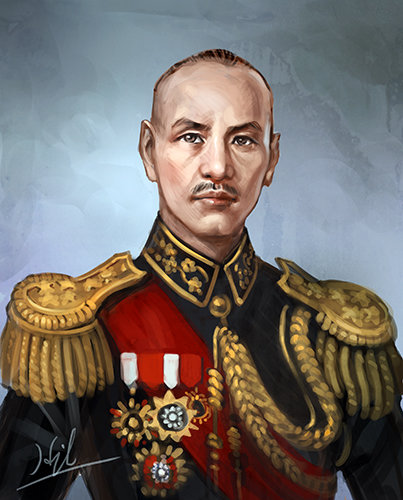
Chiang Kai-shek

Chiang Kai-shek, also romanized as Chiang Chieh-shih and known as Chiang Chungcheng, was a Chinese statesman, political and military leader who served as the leader of the Republic of China. Chiang who led the Republic of China between 1928 and 1975 was an influential member of the Kuomintang (KMT), the Chinese Nationalist Party, as well as a close ally of Sun Yat-sen's. Chiang became the Commandant of the Kuomintang's Whampoa Military Academy and took Sun's place as leader of the KMT following the Canton Coup in early 1926. Having neutralized the party's left wing, Chiang then led Sun's long-postponed Northern Expedition, conquering or reaching accommodations with China's many warlords. From 1928 to 1948, Chiang served as chairman of the National Military Council of the Nationalist Government of the Republic of China (ROC).


Chiang was socially conservative, promoting traditional Chinese culture in the New Life Movement and rejecting both western democracy and Sun's nationalist democratic socialism in favour of an authoritarian government. Unable to maintain Sun's good relations with the communists, Chiang purged them in a massacre at Shanghai and repression of uprisings at Guangzhou and elsewhere. At the onset of the Second Sino-Japanese War, which later became the Chinese theater of World War II, Zhang Xueliang kidnapped Chiang and obliged him to establish a Second United Front with the communists. After the defeat of the Japanese, the American-sponsored Marshall Mission, an attempt to negotiate a coalition government, failed in 1946. The Chinese Civil War resumed, with the Chinese Communist Party (CCP) led by Mao Zedong defeating the Nationalists and declaring the People's Republic of China in 1949. Chiang's government and army retreated to Taiwan, where Chiang imposed martial law and persecuted critics in a period known as the "White Terror". After evacuating to Taiwan, Chiang's government continued to declare its intention to retake mainland China. Chiang ruled Taiwan securely as President of the Republic of China and General of the Kuomintang until his death in 1975, just one year short of Mao's death. Similarly to that of Mao, Chiang is regarded as a controversial figure: supporters credit him with playing a major part in the Allied victory of the Second World War; detractors and critics denounce him as a dictator at the front of an authoritarian autocracy who suppressed and purged opponents and critics and arbitrarily incarcerated those he deemed as opposing to the Kuomintang among others.
Thursday, September 21, 2017

Ernesto "Che" Guevara

Che Guevarra was an Argentine Marxist revolutionary, physician, author, guerrilla leader, diplomat and military theorist. A major figure of the Cuban Revolution, his stylized visage has become a ubiquitous countercultural symbol of rebellion and global insignia in popular culture. As a young medical student, Guevara traveled throughout South America and was radicalized by the poverty, hunger and disease he witnessed. His burgeoning desire to help overturn what he saw as the capitalist exploitation of Latin America by the United States prompted his involvement in Guatemala's social reforms under President Jacobo Árbenz, whose eventual CIA-assisted overthrow at the behest of the United Fruit Company solidified Guevara's political ideology. Later in Mexico City, Guevara met Raúl and Fidel Castro, joined their 26th of July Movement and sailed to Cuba aboard the yacht Granma with the intention of overthrowing U.S.-backed Cuban dictator Fulgencio Batista.


Guevara soon rose to prominence among the insurgents, was promoted to second-in-command and played a pivotal role in the victorious two-year guerrilla campaign that deposed the Batista regime. Following the Cuban Revolution, Guevara performed a number of key roles in the new government. These included reviewing the appeals and firing squads for those convicted as war criminals during the revolutionary tribunals, instituting agrarian land reform as minister of industries, helping spearhead a successful nationwide literacy campaign, serving as both national bank president and instructional director for Cuba's armed forces and traversing the globe as a diplomat on behalf of Cuban socialism. Such positions also allowed him to play a central role in training the militia forces who repelled the Bay of Pigs Invasion and bringing the Soviet nuclear-armed ballistic missiles to Cuba which precipitated the 1962 Cuban Missile Crisis. Additionally, Guevara was a prolific writer and diarist, composing a seminal manual on guerrilla warfare, along with a best-selling memoir about his youthful continental motorcycle journey. His experiences and studying of Marxism–Leninism led him to posit that the Third World's underdevelopment and dependence was an intrinsic result of imperialism, neocolonialism and monopoly capitalism, with the only remedy being proletarian internationalism and world revolution. Guevara left Cuba in 1965 to foment revolution abroad, first unsuccessfully in Congo-Kinshasa and later in Bolivia, where he was captured by CIA-assisted Bolivian forces and summarily executed. Guevara remains both a revered and reviled historical figure, polarized in the collective imagination in a multitude of biographies, memoirs, essays, documentaries, songs and films. As a result of his perceived martyrdom, poetic invocations for class struggle and desire to create the consciousness of a "new man" driven by moral rather than material incentives, Guevara has evolved into a quintessential icon of various leftist movements. Time magazine named him one of the 100 most influential people of the 20th century, while an Alberto Korda photograph of him, titled Guerrillero Heroico (shown), was cited by the Maryland Institute College of Art as "the most famous photograph in the world".

Monday, September 11, 2017

Sabo

Sabo is the Revolutionary Army's chief of staff, recognized as the "No. 2" of the entire organization, ranking directly under Monkey D. Dragon himself. Next to being the sworn brother of Monkey D. Luffy and Portgas D. Ace, he is of noble descent, the son of Outlook III, as well as via his parents the adopted brother of Stelly, the current king of the Goa Kingdom, whom Sabo has never recognized as such. As a child, Sabo already have a very high level of physical capabilities and fighting skills, since he and Ace together were able to topple Porchemy when the two of them arrived to save Luffy. Sabo was able to beat Luffy fifty times in one day, as well as defeat Ace twenty four times and lose twenty six times. He was fast enough to grab a knife from a pirate without the pirate being able to stop Sabo. He was good at thieving as well, since he and Ace were able to rob a large amount of people to get their money and valuables.

Sabo
He also was exceptionally skilled in stealth and could jump out of a window several stories up without injuring himself. According to Ace, who thought Sabo would become his navigator, the boy also had some experience in navigation. After joining the Revolutionary Army, Sabo was personally trained by Monkey D. Dragon.By the time he was 22, he achieved the rank of Chief of Staff, and thus the second in command, of the Revolutionary Army. As a result, he has command over all other lower ranking members of the Revolutionary Army, and answers only to the leader himself. His bounty of 602,000,000 Beli proves that the World Government views him as extremely dangerous.


Revolutionary Army's chief of staff Sabo

Sabo later defeated Burgess by the time Luffy defeated Doflamingo. Burgess asked Sabo if he was going to kill him, but Sabo replied that he had no need to. Burgess then taunted Sabo by telling him what Ace said after Blackbeard captured him. In anguish, Sabo then grabbed Burgess on the face. Burgess grabbed his knife and went in for the kill, but Sabo blew him away with Fire Fist. Sabo was then contacted by Koala, who was waiting for him at the underground trade port. Sabo asked Koala if she found a list before hanging up on her. After things had settled down and Luffy and his friends went to Kyros' house to rest, Sabo went there during the night to see Luffy's face one last time. He told Robin that he would be leaving Dressrosa because CP-0 was coming back for the revolutionaries. After Zoro expressed his surprise at discovering that Luffy had another brother besides Ace, Sabo noted that it was probably most surprising for Luffy, as he had thought he was dead. He then went on to explain his past to Zoro, Franky, and Robin. Before departing, he gave Zoro a Vivre Card for Luffy and kept a piece for himself. He then entrusted Luffy's safety to the Straw Hats before leaving the house, something Zoro found amusing, since Ace had done the same thing two years prior when they met in Alabasta. Sabo then contacted Hack before heading for the harbor on a flock of birds. The revolutionaries later left Dressrosa and they apparently took all the weapons and evidence relating to the Donquixote Family's smuggling operation before CP-0 could recover them. Sometime later, a newspaper explained about Blackbeard's attack on Baltigo. The island was destroyed by the time the Marines and Cipher Pol arrived. However, Sabo and the revolutionaries' fate remains unknown.